
Stop Optimizing the Funnel. Fix the Middle.
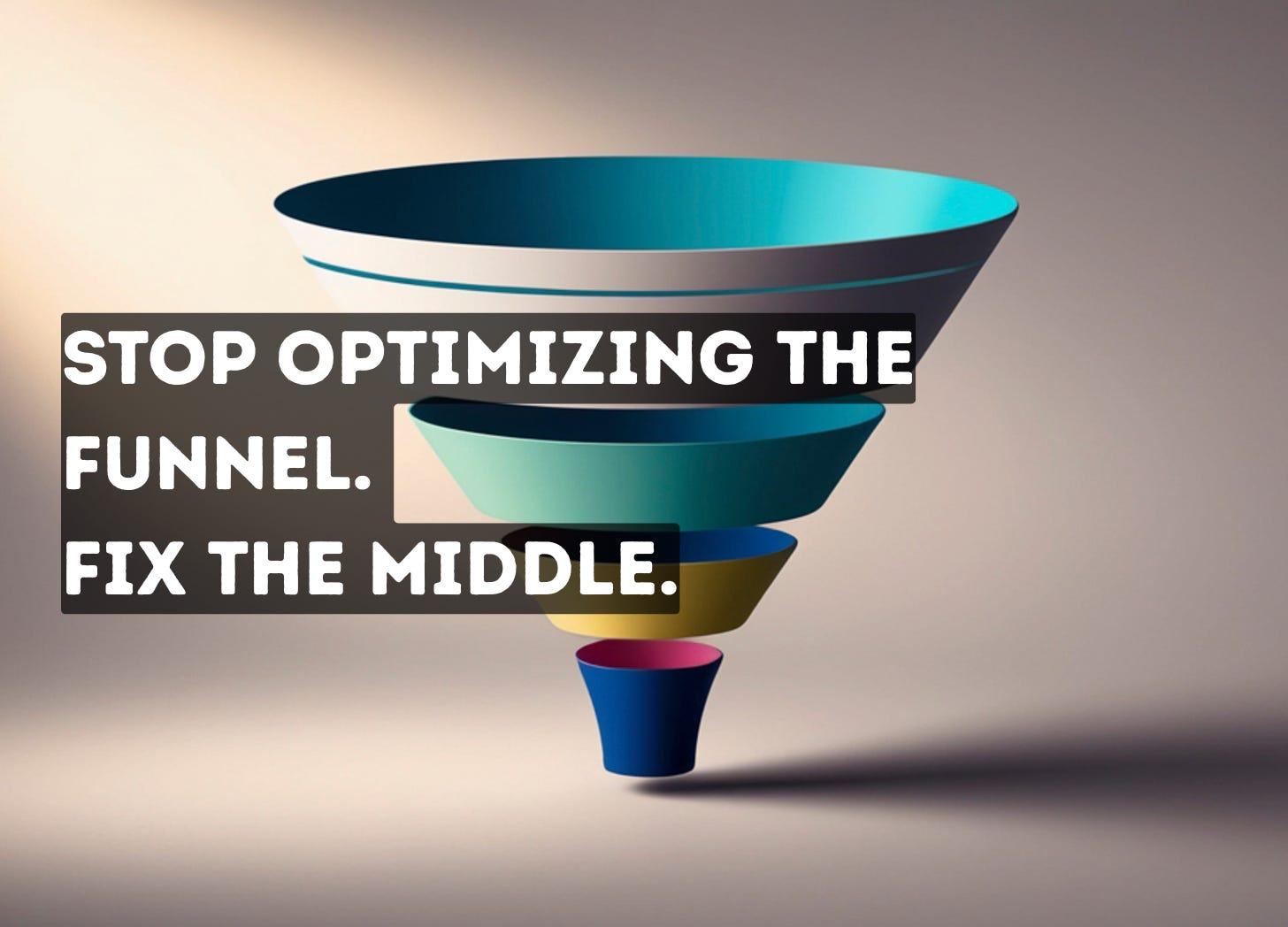
Most startups obsess over two things:
Top of funnel.
Churn.
Traffic and retention.
They A/B test ads.
They tweak headlines.
They lower CAC.
They analyze churn reasons.
Meanwhile, the real problem sits quietly in the middle.
The messy middle.
The place where users:
sign up
try a few things
hesitate
drift
never quite commit
Not churned.
Not retained.
Just… floating.
That’s where growth is actually won or lost.
The funnel lie
Funnels look clean.
Visitors → Signups → Activated → Retained → Paid.
It feels linear.
It feels controllable.
But real user behavior is not a straight line.
It’s messy.
Between activation and retention, there’s a long stretch of ambiguity.
Users are:
partially engaged
inconsistently active
unsure about value
not fully committed
And that’s the part most teams ignore.
Why the middle matters more than traffic
Let’s say:
1,000 people visit
100 sign up
40 activate
10 retain
Most founders try to:
increase 1,000
decrease churn from 10
But what if you focused on moving 40 to 60 instead?
Deepening engagement often creates more growth than increasing awareness.
Because depth compounds.
Traffic doesn’t.
The middle is where habits are formed
The first visit is curiosity.
Retention is habit.
The middle is transition.
It’s where users decide:
“Is this part of my workflow?”
If you lose them here, no amount of retargeting will fix it.
Signs your middle is broken
You’ll see patterns like:
Good signup numbers, weak week-2 usage
Strong activation, soft ongoing engagement
Many “one-time” users
Inconsistent usage spikes
Users who log in but don’t complete core actions
They’re not gone.
But they’re not growing with you either.
That’s middle decay.
The Middle Audit
If growth feels flat, run this instead of launching new ads.
1️⃣ Measure depth, not just activity
Ask:
How many users complete the core action twice?
Three times?
Five times?
Not “Did they use it?”
But “Did they repeat it?”
Repetition predicts retention better than signups.
2️⃣ Measure frequency
How often do retained users use your product?
Daily?
Weekly?
Monthly?
Then compare:
How often do “almost retained” users use it?
The gap between those two groups is your middle problem.
3️⃣ Identify friction between first and fifth use
Activation gets them to use it once.
But what blocks the second, third, fourth use?
Common friction:
unclear next step
empty states
lack of templates
too much setup
no visible progress
If your product only feels valuable on the first try, it won’t stick.
4️⃣ Check progression signals
Do users see growth?
Are their results improving?
Are dashboards evolving?
Are insights compounding?
If nothing visibly changes over time, users feel static.
Static products lose momentum.
The habit bridge
The middle needs a bridge from curiosity to habit.
That bridge usually includes:
guided repetition
visible improvement
structured next steps
gentle nudges
reduced friction after first success
Your job is not to increase features.
It’s to increase meaningful repetition.
A simple exercise
Take your most retained users.
Ask:
“What did they do in their first 14 days?”
Map their behavior.
Now compare it to:
Users who activated but didn’t retain.
The difference between those two journeys is your middle gap.
That gap is more important than your ad strategy.
Why founders skip this
Because it’s less glamorous.
You can’t screenshot “middle optimization.”
You can’t brag about “increased depth per user.”
But this is where compounding happens.
Retention is not saved at the exit.
It’s built in the middle.
Final thought
Top of funnel fills the bucket.
Retention keeps the water.
The middle decides if there’s a hole.
Before you chase more traffic or panic about churn, look at the users who are still here but not fully engaged.
Fix the middle.
Growth usually follows.